


Combat Style Comparison
How Faye's combat reads against the Norse games we already know.
Combat Overview
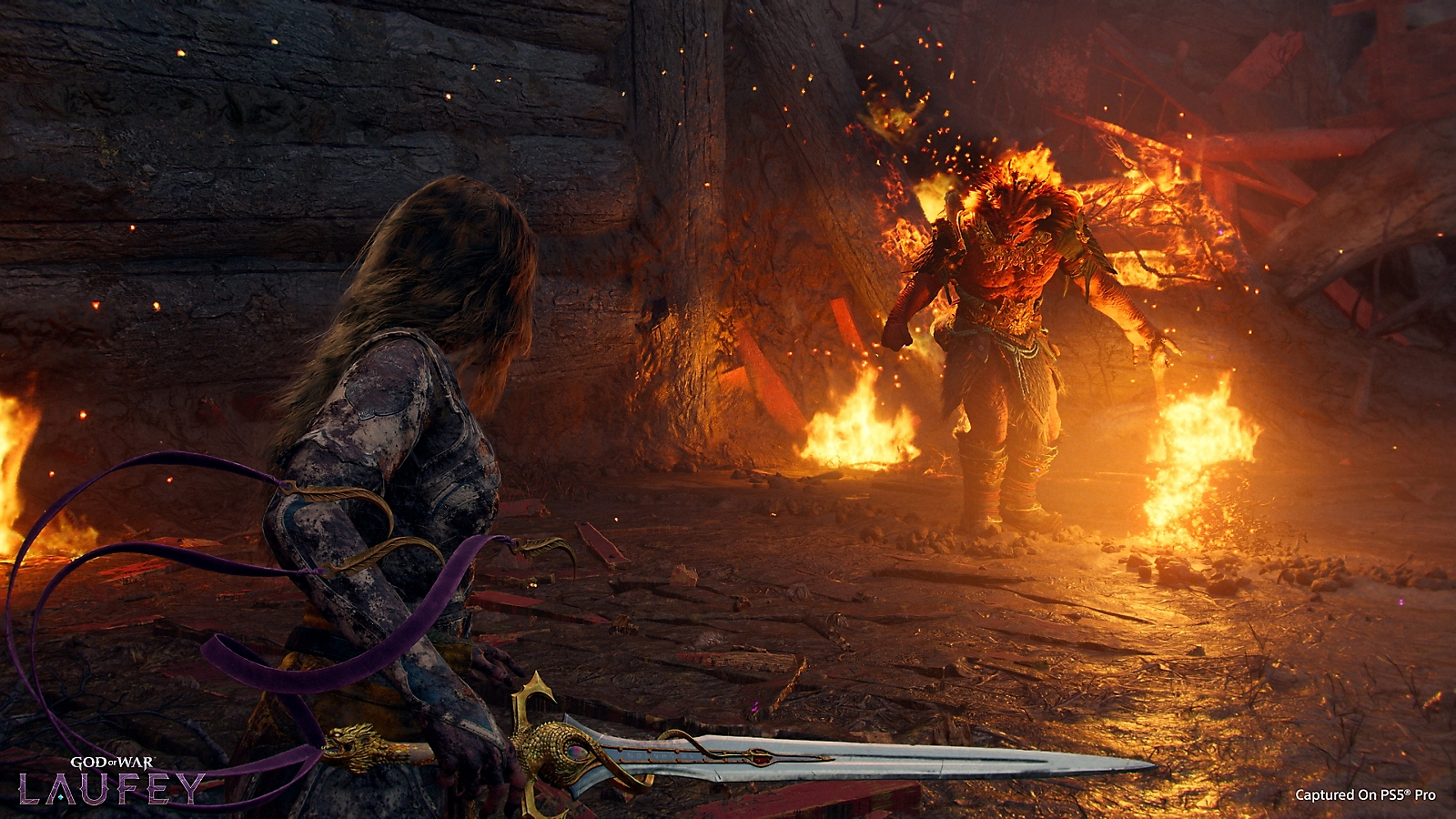
Based on the State of Play reveal, God of War Laufey still looks unmistakably like a modern God of War game, but Faye's movement gives it a different rhythm. The footage trades some of Kratos' planted heaviness for sharper repositioning, quicker strings, and a more nimble flow.
Developers have described Faye as “just as strong and just as good a warrior” as Kratos, but more “acrobatic” — a deliberate distinction that positions her as equally lethal with a lighter, more agile fighting philosophy. Where Kratos plants and powers through, Faye flows and accelerates.
vs. God of War (2018)
- Pace — The reveal suggests less pause between actions and more constant movement
- Body Language — Faye fights lighter on her feet than Kratos ever did in 2018
- Axe Rhythm — If the Leviathan Axe returns, it would have different timing and spacing priorities from Kratos' use. Note: Faye's primary weapon appears to be a one-handed sword paired with free-hand Golden Hand abilities
- Companion Feel — Phranque appears to affect encounters differently than Atreus' ranged support
vs. Ragnarök
- Mobility — Faye seems to change angles faster and reset pressure more often
- Magic — Her effects feel more native to her style instead of bolted on like a separate move slot
- Readability — The combat is quicker, but it still looks built around impact and clarity rather than pure spectacle
vs. The Original Greek Trilogy
The Combat First Look trailer made it explicit: Faye's combat draws directly from the PS2-era Greek trilogy's DNA. Santa Monica Studio described the approach as“Building upon modern GoW combat while injecting classic Greek DNA — fresh yet familiar.”
- Air Juggles — The original trilogy let players keep enemies airborne through chained attacks. Faye brings this back with the added dimension of double jumps, making aerial strings even more flexible than the PS2 era
- Combo Grapples — Grabbing enemies mid-combo to reposition or launch them was a Greek-era staple. Faye uses grapples as connectors between ground and air phases
- Ground Slams — Bringing aerial momentum down into heavy impacts closes the air-to-ground loop, exactly like the original games' finisher cadence
- Speed and Fluidity — The Greek games were faster and more chain-oriented than the Norse titles. Faye's momentum system restores that chaining freedom while keeping modern weight
Eurogamer went as far as describing the result as “like a lighter version of Devil May Cry,” which speaks to how far the combat has moved toward character-action fluidity compared to both the Norse games and the original trilogy.
One-Handed Sword vs. Two-Handed Power
Beyond individual moves, the most fundamental difference is in the weapon architecture:
- Kratos (Norse era) — Two-handed weapons (Leviathan Axe, Blades of Chaos) used as discrete loadouts. Heavy, deliberate strikes. Magic is equipped as separate runic attack slots
- Kratos (Greek era) — Two-handed chain weapons (Blades of Athena/Exile) with built-in magic. Faster chaining but still weapon-first, magic-second
- Faye — One-handed sword for physical offense, free hand for magic/parry/Golden Hand simultaneously. No loadout switching — both layers run at once
Faye's architecture is the biggest mechanical departure in the series' history. She is not just faster Kratos — she is built on a fundamentally different principle where physical offense and magical control are parallel tracks rather than sequential choices.
Momentum System vs. Kratos' Rhythm
The Combat First Look confirmed that Faye operates on a momentum-basedcombat system: “building momentum from one strike to the next, across the ground or into the sky.”
- Kratos' rhythm — Deliberate, planted strikes that reset between moves. Power comes from each individual hit's impact
- Faye's momentum — Each strike feeds the next, gaining speed and intensity. Power comes from the chain itself, not any single hit
This is the core tension in Laufey's combat identity. Kratos fights like a force of nature — unstoppable, methodical, overwhelming. Faye fights like a precision instrument — accelerating, redirecting, and keeping enemies off-balance through sustained pressure rather than brute force.
Bear McCreary & Combat Rhythm
Bear McCreary's confirmed return as composer is not just a production credit — it has direct implications for combat feel. McCreary's scores for GoW 2018 (BAFTA-winning) and Ragnarök were designed to sync with the combat's emotional rhythm, swelling during boss moments and pulling back during exploration.
For Laufey, the faster momentum-based combat likely demands a different musical approach — one that sustains intensity across longer combo strings rather than punctuating individual power hits. If the Greek trilogy comparison holds for the music as well, expect more driving percussion and less contemplative scoring than the Norse games.
What Still Feels Like God of War
Even with the extra speed, the reveal does not read like the series is abandoning its identity. Hits still look weighty, enemy reactions still matter, and the camera framing still sells that close, tactile Norse-era feel instead of turning into a pure style-combo showcase.
ℹ️ Pre-Release Comparison