

Egyptian Mythology
The myth thread longtime fans have been side-eyeing for years — now anchored by Sekhmet and finally peeking into the series proper.
ℹ️ Pre-Release Content
Egyptian Mythology in God of War Laufey
Egyptian mythology is one of the two new mythological systems officially confirmed for God of War Laufey, alongside Mongol mythology. While Norse mythology remains the emotional backbone of the story, the Everywhen's premise — an afterlife where dead gods from every mythology converge — opens the door for Egyptian deities to play a direct role.
For longtime fans, this is not a surprise. Egypt has been the most discussed “next destination” in the God of War community since the Norse era began. The original concept for the 2018 reboot was set in Egypt — concept art and early interviews confirm that Santa Monica Studio seriously explored it before settling on Norse mythology. Laufey feels like the moment that shelved thread finally surfaces.
Sekhmet — Goddess of War, Plague, and Healing
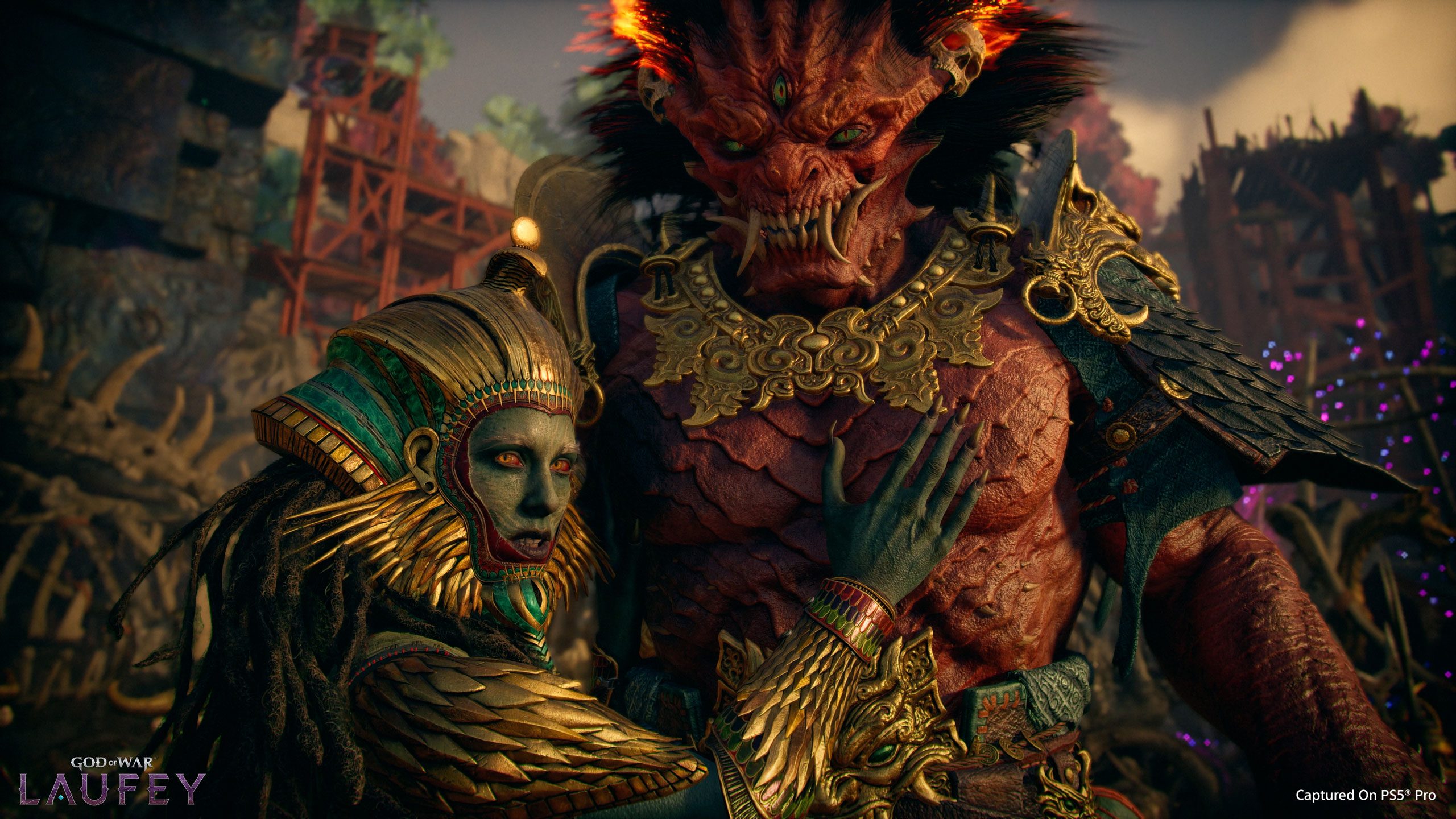
Sekhmet is the most detailed named god from any non-Norse mythology in God of War Laufey so far — and per Wikipedia's August 2026 revision, she is officially positioned as one of the game's announced antagonistic characters, not just a named encounter. According to the IGN exclusive interview with Ariel Lawrence and Cory Barlog, she is tied to plague, vengeance, healing, and the sun— a composite portfolio that makes her one of Egyptian mythology's most dangerous and complex figures.
In traditional Egyptian lore, Sekhmet was created by the sun god Ra to punish humanity for its disobedience. She nearly wiped out the entire human race before being tricked into drinking beer dyed red to look like blood, which calmed her destructive rage. That myth gives her a built-in narrative arc: overwhelming power barely held in check.
Ariel Lawrence described Sekhmet's presence in the Everywhen as carrying “that gravitas, that menace, that commanding presence” — framing her as a figure who can stand as an even match for Faye rather than a simple boss encounter. The IGN interview also noted that Sekhmet carries what Lawrence described as “psycho mean girl” personality elements, suggesting a character who is both charismatic and terrifying.
Sekhmet's Role in the Everywhen
Within the Everywhen's power structure, Sekhmet is not an isolated encounter. She is paired with Begtse, the Mongolian God of War, who serves as her “afterlife bodyguard.” This pairing suggests the Everywhen's social hierarchy involves alliances and factions, not just random boss fights scattered across the landscape.
Lawrence described wanting to “showcase that feeling of an even match” between Sekhmet and Begtse, which hints that their dynamic — protector and protected, or something more complicated — will play a meaningful role in the story. Whether Sekhmet is an antagonist, a reluctant ally, or something that shifts over the course of the narrative remains to be seen.
The Egyptian Pantheon — What Else Might Appear
While Sekhmet is the only confirmed Egyptian god, the Everywhen's premise — “the afterlife of the gods of all mythologies” — means that any dead Egyptian deity could theoretically appear. Some of the most likely candidates based on mythological significance and series relevance:
- Ra— The sun god and Sekhmet's creator. If Sekhmet's backstory is explored, Ra's shadow looms large. His role in creating Sekhmet as a weapon of punishment ties directly to the Everywhen's themes of divine power abuse.
- Anubis— God of the dead and mummification. In a setting defined by the afterlife, Anubis is a natural fit. His domain overlaps directly with the Everywhen's core concept.
- Osiris — God of the underworld and resurrection. His own myth involves death and rebirth, making him thematically relevant to the Everywhen.
- Horus— God of kingship and the sky. One of the most recognizable Egyptian deities and a potential rival or ally in the Everywhen's power struggles.
- Thoth — God of wisdom and writing. If the Everywhen involves uncovering ancient knowledge or navigating complex mythic rules, Thoth would be a logical presence.
This list is speculative. Only Sekhmet has been officially confirmed, and any other Egyptian deities are educated guesses based on mythology and narrative fit.
Why Egypt Matters to God of War Fans
Egyptian mythology has sat on the edge of God of War discussion for nearly a decade. When Santa Monica Studio rebooted the series with God of War (2018), early concept art and interviews revealed that Egypt was a serious contender for the new setting before Norse mythology was chosen. Cory Barlog has spoken about how Egypt's visual richness and mythic depth made it a compelling alternative.
In God of War (2018) itself, there are subtle Egypt-coded moments — Kratos' journey briefly brushes against the edges of other mythological territories. And in the larger God of War universe, the idea that Kratos left Greece and could have traveled to any pantheon's domain has always fueled fan speculation. Egypt was consistently the #1 fan guess for where the series would go next.
Laufey doesn't deliver that full Egyptian game — but it does something potentially more interesting. By placing Egyptian deities inside the Everywhen alongside Norse, Mongol, and potentially other mythologies, the game creates a mythic crossover that the series has never attempted before.
What to Expect
With Sekhmet confirmed as a named character with dialogue and a defined relationship to Begtse, Egyptian mythology is not just set dressing in Laufey — it is an active narrative thread. Key things to watch for as more information surfaces:
- Whether Sekhmet is a boss encounter, a recurring character, or a faction leader
- If other Egyptian deities beyond Sekhmet appear in the Everywhen
- How Egyptian mythic rules (afterlife structure, divine domains) interact with the Everywhen's mechanics
- Whether Faye's Guardian of the Jötnar role has any parallel or conflict with Egyptian divine authority
This page will be updated as official information is released. For the central setting that houses all mythologies, see the Everywhen page.